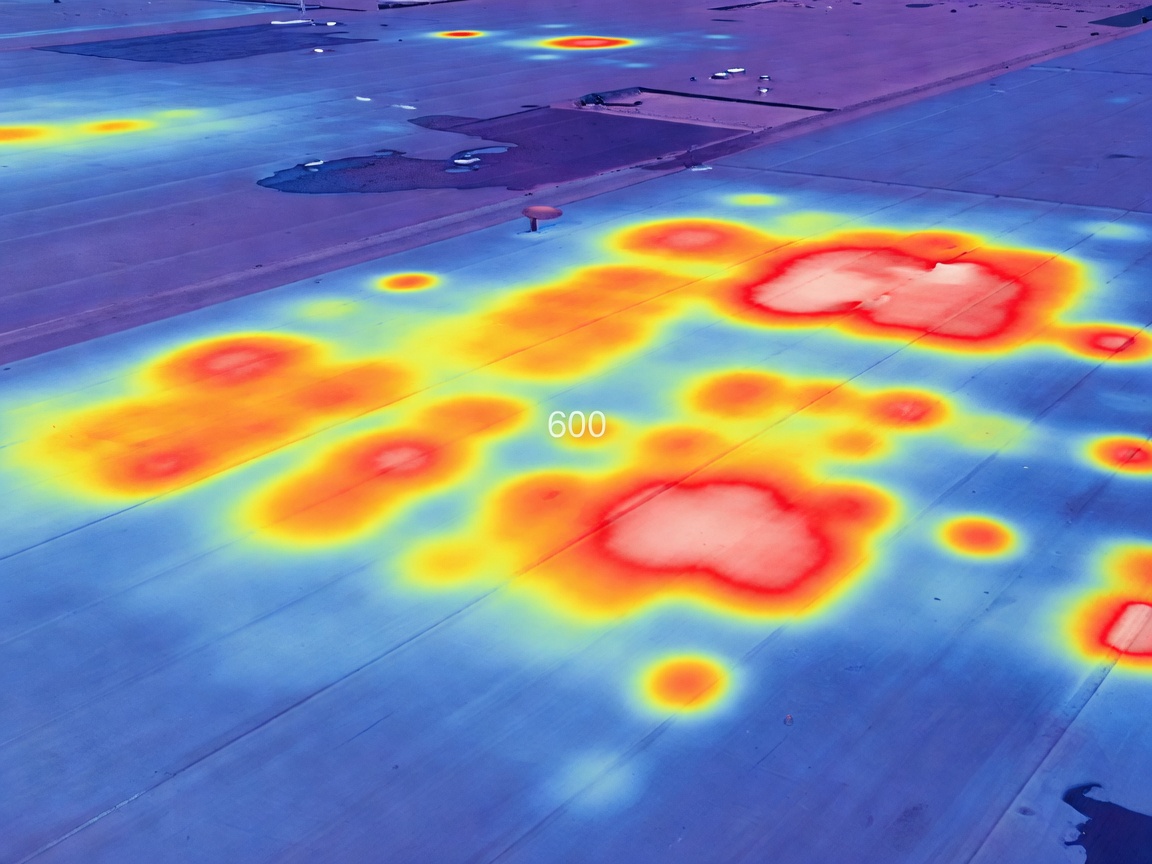
The Physics of Thermal Moisture Detection
To understand why thermal imaging is indispensable for industrial roofing, we must look at building physics. Dry insulation materials—whether polyisocyanurate (PIR), expanded polystyrene (EPS), or high-density stone wool—have exceptionally low thermal mass and low thermal conductivity. Water, on the other hand, possesses a remarkably high specific heat capacity (approximately 4,184 J/kg·K), roughly four times higher than air or dry porous cellular plastics.
Throughout the daylight hours, the sun radiates energy onto the roof deck, heating both dry and water-compromised sections evenly. However, as dusk falls and ambient temperatures drop, the dry roof components dissipate their heat rapidly into the night sky. The wet insulation sections, holding thermal energy like a sponge, retain their warmth and cool down at a much slower rate. When we sweep our radiometric infrared sensors across the roof during this critical thermal transition window, the damp sub-surface areas appear distinctly warmer than the surrounding dry roof membrane.
Comparing Methodologies: Visual vs. Thermal
Neither method should exist in isolation. Relying purely on visual data leaves you blind to hidden sub-membrane rot, while relying purely on thermal imagery can lead to false positives caused by surface dirt, varying surface emissivity, or internal factory duct exhausts. We treat them as complementary lenses:
| Evaluation Parameter | High-Resolution Visual Inspection | Radiometric Thermal Infrared Inspection |
|---|---|---|
| Primary Target | Surface tears, joint splitting, rust, blocked scuppers, cracked skylights. | Latent trapped moisture, saturated insulation boards, thermal bridging, missing insulation. |
| Operating Window | Daylight with bright, overcast conditions preferred (minimising harsh shadows). | Dusk and early evening; post-solar loading during ambient cooling drop. |
| Environmental Sensitivities | Obscured by standing puddles, heavy shadows, snow, or excessive dust. | Sensitive to wind speed (>10 knots sweeps surface heat), surface water films, reflections. |
| Diagnostic Depth | Surface level only (top sheet or outer waterproofing membrane). | Sub-surface (waterproofing layer down to vapour control and structural deck). |
| Validation Method | Direct photographic verification with mm-scale crosshair measurements. | Non-destructive electrical impedance pin-meters or calibrated core sampling verification. |
Controlling for Emissivity and Environmental Noise
Thermography is not simply pointing a camera and snapping a colourful picture; if done without strict scientific discipline, it can be wildly misleading. One of the greatest challenges we manage on industrial roofs is surface emissivity (ε). Highly reflective bare metal surfaces (such as unfinished aluminium flashings, galvanized gutters, or new standing seams) have low emissivity and act like thermal mirrors, reflecting cold sky radiation or warm chimney exhausts rather than emitting their true surface temperature.
To prevent false positive damp readings, our certified thermographers calibrate sensor parameters for atmospheric attenuation, relative humidity, reflected apparent temperature, and specific material surface emissivity. We differentiate between a true sub-surface thermal mass anomaly (which exhibits a smooth, diffuse temperature gradient) and surface-level anomalies like warm HVAC exhausts or variations in membrane colour which present sharp, hard-edged boundary lines.
The Economic Value of Targeted Insulation Replacement
When an industrial roof starts leaking inside a warehouse, traditional roofing contractors often propose complete strip-and-replace contracts costing hundreds of thousands of pounds, under the assumption that the entire insulation system has collapsed.
By conducting combined visual and thermal surveys, we map the exact, georeferenced perimeter boundaries of saturated insulation. In many facilities, we discover that although water is penetrating through several pinhole lap failures, the actual saturated insulation accounts for only 8% to 12% of the total roof square footage. This enables our clients to commission targeted, surgical cut-outs and localized overlay repairs—saving substantial capital reserves, preserving working insulation, and dramatically reducing the project's embodied carbon footprint.